A sofa can look perfect in a product photo and still feel wrong once it enters a real room. It may interrupt the main walkway, leave no space for a side table, or look visually heavier than expected. In a compact Bay Area home, those problems become obvious quickly because every inch has a job.
The best way to choose a sofa for a small living room is to make the decision in the right order: measure the room, protect traffic flow, decide how you actually sit, and then compare shape, comfort, color, and material. The sofa should support the whole room rather than force every other piece to work around it.
Short answer: Choose the largest sofa that fits without narrowing the room’s main pathways. Confirm the full footprint with painter’s tape, test the seat in person, and check the fabric or finish in lighting similar to your home.
1. Measure the room before comparing sofas
Do not begin with a number of seats. Begin with the usable floor area.
Measure the wall or zone where the sofa may sit, but also record the room’s full width and length. Note doors, windows, radiators, floor vents, outlets, built-ins, and any door that swings into the room. If the living room connects to a kitchen, dining area, balcony, or hallway, mark those routes too.
Then measure the furniture that must remain. A coffee table, media console, accent chair, or floor lamp can change the amount of space the sofa can reasonably occupy.
Before ordering, map the proposed sofa dimensions on the floor with painter’s tape. Add the chaise or return if you are considering a sectional. Walk through the room normally, open nearby doors, and imagine someone seated while another person passes. This simple test reveals problems that a floor plan can hide.
Also measure the delivery route: the narrowest doorway, hallway turns, stair landings, elevator openings, and ceiling height where the piece must be rotated. A sofa that fits the room but cannot reach it is not the right size.
For a broader room-by-room planning approach, see AYLA’s small-space furniture guide.
2. Protect traffic flow before adding more seating
In a small living room, circulation is part of the design. The room should make it easy to enter, sit down, reach a table, and move toward adjacent spaces without turning sideways around furniture.
Identify the primary path first. This is usually the route between an entry and the kitchen, dining room, patio door, or hallway. Keep that route visually clear. Secondary paths—such as the space between the sofa and a side table—can be tighter, but they should still feel natural in daily use.
A useful test is to ask: if someone is sitting on the sofa, can another person move through the room without interrupting them? If the answer is no, reduce the sofa depth, change the orientation, or remove a less important piece.
This is also why pushing every item against a wall does not always make a compact room feel larger. A carefully placed sofa can define the living zone in an open layout, as long as its back does not create a barrier across the main route.
3. Choose the sofa around how you really sit
Comfort is personal, and product dimensions do not tell the whole story. Two sofas with the same overall depth can feel very different because of cushion construction, back angle, arm width, and usable seat depth.
Think about your household’s most common posture:
- Sit upright: A more supportive back and moderate seat depth can make conversation, reading, or working on a laptop more comfortable.
- Stretch out: A deeper seat, chaise, or sofa with a matching ottoman may suit relaxed evenings better.
- Gather: A longer sofa, compact sectional, or sofa-plus-chair arrangement can make conversation easier for family and guests.
- Use the room in several ways: A flexible sofa with a movable ottoman can adapt without permanently filling one corner.
When possible, test the sofa in person for at least a few minutes. Sit as you would at home, not only at the front edge. Check whether your feet reach the floor, whether the back supports you, and whether the arms are comfortable for lounging.
4. Compare a standard sofa, loveseat, and sectional
The smallest-looking option is not automatically the most efficient one.
A standard sofa often provides the easiest layout because it leaves room for a separate chair or ottoman. A loveseat can work in a very narrow room, but it may not provide enough everyday seating on its own. A sectional can use a corner effectively and create generous seating, yet the chaise direction and overall depth need careful planning.
For many small living rooms, a simple sofa plus one movable chair is more adaptable than a large sectional. The chair can turn toward guests, move near a window, or leave the room temporarily when more open floor space is needed.
If you prefer a sectional, confirm which side the chaise belongs on while facing the sofa. Product terminology varies, so rely on a diagram rather than the words “left” or “right” alone. Make sure the chaise does not cut across the main pathway or stop a door from opening fully.
Browse AYLA’s current sofa collection to compare silhouettes before visiting the showroom.
5. Look at visual weight, not only width
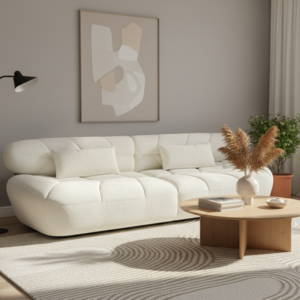
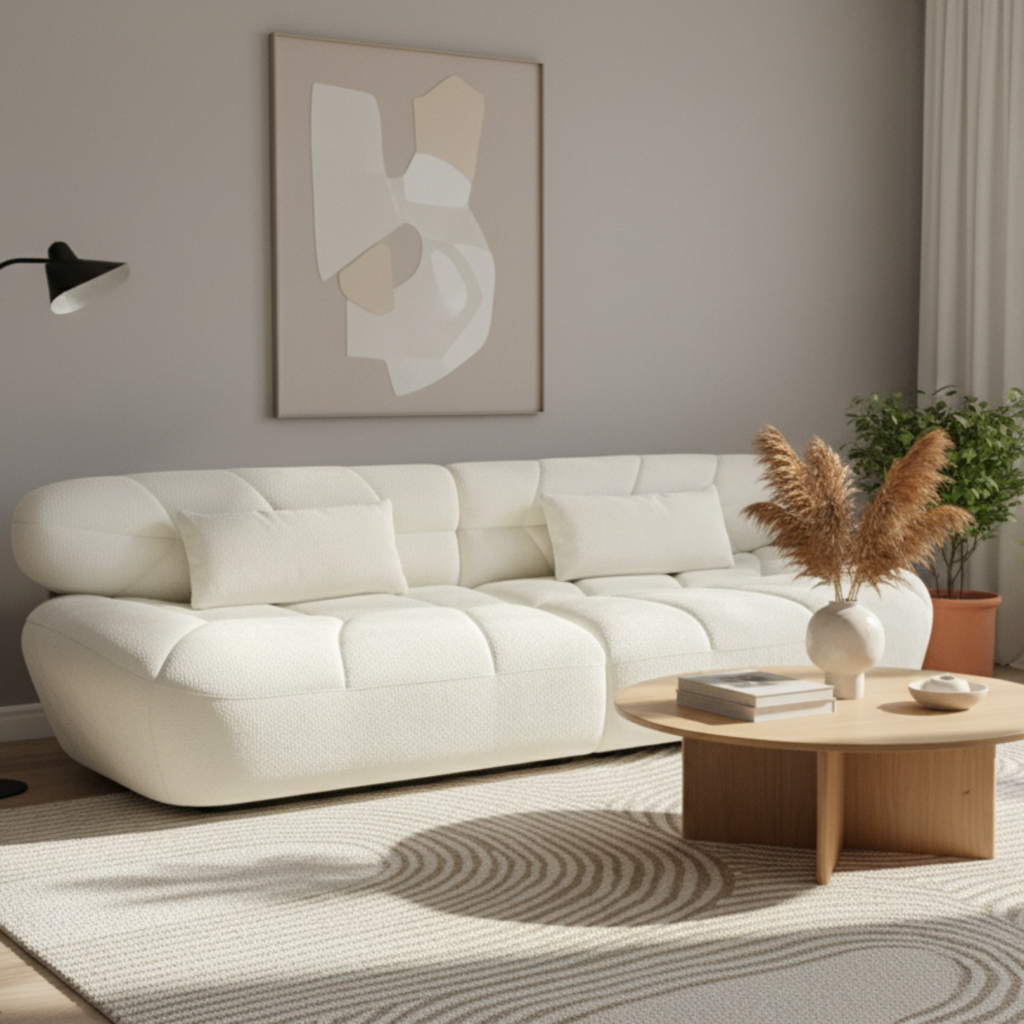
Two sofas with identical widths can occupy a room very differently. Thick arms, a high back, a skirted base, dark upholstery, and large loose cushions create more visual weight. Slim arms, visible legs, a lower back, and some floor showing beneath the frame often read lighter.
That does not mean every small room needs a pale, leggy sofa. A grounded or sculptural piece can become a strong focal point. The goal is balance. If the sofa has a substantial form, keep nearby tables visually quieter and leave enough open space around it. If the sofa is light and streamlined, you may have room for a more expressive chair, lamp, or coffee table.
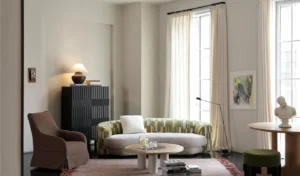
Curved sofas can soften a boxy room and support conversation, but the curve also creates unused pockets of floor area. Tape the complete footprint before choosing one for a tight layout.
6. Check color and texture in real light
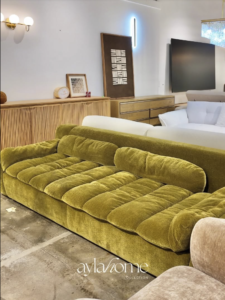
Upholstery changes throughout the day. A warm cream may read yellow in one room and nearly gray in another. Bouclé, velvet, woven fabric, and leather also reflect light differently, which affects both color and visual weight.
When comparing samples, view them vertically as well as flat. A swatch lying on a table receives light differently from fabric on the front or back of a sofa. Look at the sample near your wall color, flooring, rug, and window during the times of day when you use the room most.
Lifestyle matters as much as appearance. Ask how the material should be cleaned, whether cushion covers are removable, how the texture handles daily use, and whether the color is forgiving for your household. Avoid assuming that one fabric is universally “family friendly”; the right choice depends on the actual material, care instructions, and the way your home functions.
7. Plan the furniture around the sofa
Once the sofa footprint is confirmed, test the supporting pieces as one composition rather than making separate purchases.
The coffee table should be easy to reach without closing the passage through the room. A small round or oval table can soften tight circulation paths because it has no projecting corners. Nesting tables or a movable ottoman can provide surface area only when needed. Slim side tables are useful when a full coffee table would make the center of the room feel crowded.
Check the relationship between the sofa and the rug too. A rug that is visibly connected to the seating usually feels more intentional than a small rug floating in the center. In a very compact room, even placing the sofa’s front legs on the rug can help connect the arrangement.
Finally, consider sightlines. From the room’s entrance, the sofa should not hide the most attractive feature or make the space feel closed. In an open living and dining area, repeat one or two colors or materials beyond the living zone so the sofa belongs to a larger visual story.
A sofa-measurement checklist to bring shopping
Save these details on your phone before you compare options:
- Full room width and length
- Maximum sofa width and depth
- Window, door, outlet, and vent locations
- Main walking paths
- Existing rug, coffee table, and media-console sizes
- Doorway, hallway, stair, and elevator measurements
- Photos taken from each corner of the room
- A short note on how your household prefers to sit
- Wall, flooring, and rug photos in natural light
- Any pets, children, or care requirements that affect upholstery choice
This information makes showroom comparisons much more useful. Instead of asking whether a sofa is attractive in isolation, you can evaluate whether it solves the right problem in your home.
Frequently asked questions
What sofa style makes a small living room look bigger?
A sofa with a visually open base, moderate depth, and arms that do not consume too much width often feels lighter in a small room. However, correct scale and clear pathways matter more than any single style feature.
Is a sectional a bad choice for a small living room?
No. A compact sectional can use a corner efficiently and replace several separate seats. It becomes a problem when the chaise blocks circulation, the depth overwhelms the room, or the fixed configuration leaves no flexibility.
Should a small living room use a loveseat instead of a sofa?
Only if the room truly requires it. A loveseat saves width, but a slightly longer sofa may provide better everyday seating without using much more floor area. Compare the complete footprint and the number of people who use the room.
What should I bring when shopping for a sofa?
Bring room and delivery-route measurements, photos of the space, images of the pieces that will remain, and a note about how you prefer to sit. Fabric or finish samples from your home are helpful when available.
Choose the room first, then the sofa
Learning how to choose a sofa for a small living room is less about finding the smallest model and more about making a complete plan. Measure the room and delivery route, protect the paths you use every day, choose for your real sitting habits, and compare the material in realistic light.
If you are shopping in the Bay Area, bring your measurements and room photos to AYLA Home Collection’s San Jose showroom. You can compare sofa scale, seat feel, shape, and finish in person before deciding what belongs in your home.